Why most marketing advice doesn’t work for novelists, and what I’m proposing we do instead
If you’ve been in the author/aspiring author space for any length of time, you know there are hundreds of gurus, or Gmail scammers, online telling you that they’ve cracked the code to help your book become a bestseller (for a hefty price tag, of course).
That’s not what this post is.
I’m choosing to share my honest experience during my first year marketing my contemporary fiction novel because, about two weeks ago, I had a thought pop into my head that I chose to post here on Substack, and the response to it caught me completely off guard.
For context, like most people on this platform, I’m generally over here getting a like or two—or crickets—on my Notes.
Here’s said post:
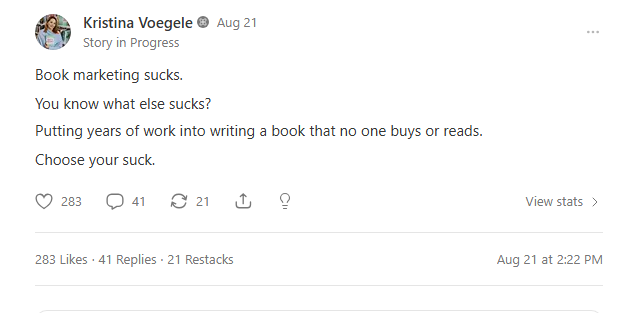
This clearly struck a nerve. When I had this thought, like so many authors, I was genuinely frustrated. I’d pushed really hard marketing my book leading up to my launch and had about a month or two of content cued up afterward. But after that, I totally crashed.
I was exhausted and I didn’t know what to do next (other than start writing the next book). So, I gave myself permission to slow down on the marketing front. But when my sales slowed down significantly after a couple of months of next to no marketing, I started feeling guilty for not doing more.
The truth is, I wanted to spend my time and creative energy writing stories, not content. But, at the same time, I also wanted to build off of the momentum of Book 1 for the next book in the series. And I knew there was no momentum without marketing.
In other words, I felt this constant push/pull of not wanting to market but worrying I was self-sabotaging when I didn’t.
Why marketing fiction is harder than almost anything else
I’m almost 20 years into a copywriting career helping brands sell products with words.
I give you this context to admit that I came into this author marketing thing with a supposed “leg up.” Marketing a book should have been easy for me!
SPOILER: IT WASN’T.
It isn’t.
And here are just a few reasons why:
Ever notice that most of the marketing advice for authors is specifically talking to non-fiction authors?
It’s because marketing fiction is not nearly as intuitive or formulaic as marketing non-fiction.
Non-fiction authors can market themselves exactly the same way coaches do. It’s “expert” marketing, and it works because it’s a problem/solution-based sales strategy. (Just like those ads that promise to help you sell more books are.)
Let’s say someone writes a book called Retire by 40.
With a clear payoff, and audience (financially motivated people under 40) there’s a clear “in” for bulk orders (the fastest way to get yourself onto a bestsellers list), speaking gigs, podcasts, and media hits. The author can literally pull a year’s worth of content for social media directly from their book and know it’s going to land for their ideal reader.
Why? Because they’re offering a solution to a problem, or a tangible benefit, that someone already wants.
And it’s a lot easier to convince someone to spend money when you’re promising to help them make money on the other side.
Here’s the rub for fiction authors though. . .
Defining why someone should devote hours of their busy lives reading a story we made up in our pajamas is not quite as obvious.
Hence, why so much of the marketing advice out there just doesn’t land or convert for novelists.
Another real obstacle we’re up against. . .
Growing supply and shrinking demand
Here’s what I know for sure 1 year into this:
Selling novels is hard. Full stop.
I’m not saying this to be negative.
I’m saying it as a form of solidarity.
You’re not doing anything wrong.
The market is just insanely saturated.
Here are some real stats for you to grasp the full picture of what authors are up against:
According to Publisher’s Weekly, in 2005, about 282,500 titles were published a year. In 2025, it was 4.2 million. Yes, this insane increase is because of self-publishing. That’s the point. The gates are open, and anyone can walk through them now. (Even the robots, so let’s assume this number is likely to go up. Sigh.)
New titles only make up for about 30% of book sales a year for the Big Five Publishers (the only source of real data). Which means debut authors (no matter how they’re published) aren’t only competing with the other 4.2 million NEW releases, we’re also competing with everything that’s still in print.
And on the demand side of the equation, according to a University of Florida/University College London study, the rate of Americans who read for pleasure on any given day dropped from 28% in 2004 to 16% in 2023. That’s a 40% decline.
BOTTOM LINE:
There are fifteen times MORE books coming out every year than there were in the early 2000’s, and there are forty percent FEWER people reading
for pleasure on any given day.
Reality Check:
The odds of a traditionally published, agented author landing on the NYT Bestsellers List are about the same as a Major League baseball player’s chance of making it into the Baseball Hall of Fame (around 1%)
Why Playing the Long Game is the Answer Hiding in Plain Sight
I imagine right now you’re probably saying, “Okay great. So, the marketing gurus don’t know how to sell my books. And the market sucks for books. Why even bother.”
Well, if you’re here and still reading this, I’m guessing it’s because you really love writing stories, otherwise you should do ANYTHING else with your time. Seriously. I think of being an author like a lot of people think about being an actor or a teacher. You don’t get into it to make a lot of money. You do it because you wouldn’t be happy doing anything else.
And because we love it so much, that also makes us more prone to spend money on it, hence why were all inundated with scammers telling us they know how to get our books to our audience better than we do. They’re selling us their “solution” to our “problem.”
But, after a year of officially being an author, and 20 years in the marketing space (five of which was building my own online business with expert marketing) I can tell you that the marketing advice doesn’t work because it was built for a different kind of product. And here’s a spoiler for you—the strategies that actually sold books for me were largely free.
It took me almost an entire year to grasp this, but here it is:
Novels, at their core, are entertainment and therefore need to be marketed differently than a product that offers a solution to a problem.
Don’t look at a thought leader’s framework for how to sell your novel.
It’s a better comparison to think about why you watched the last show you binged or why you bought tickets to a movie.
I’m guessing it was for one of two reasons:
Someone you know, like and trust recommended it
or
The trailer or description promised you the vibe you were after at that moment
(And the algorithms on your TV know what you like based off of what you’ve watched before)
This is the truth about marketing fiction. It’s entertainment. It’s not as much about a personal brand or “platform”. This matters for thought leaders—but not so much fiction authors.
I read all of Abby Jimenez’s novels because I know what kind of entertainment I’m going to get from her books. I don’t need to know anything about her as a person or her life to feel like it’s a safe bet buying the next book she puts out.
The marketing for novels that’s going to be the most effective is incredibly simple.
It’s a friend telling another friend, “You have to read this.”
What actually sold copies of my book this year was almost embarrassingly analog given the copious amount I know about digital marketing.
It wasn’t funnels, or ads. It was displaying it in local shops. Asking for support from family and friends. It was connecting like a real human with people online.
I’ll break it all down in my next post for my official “What worked/what didn’t” marketing post-mortem celebrating officially becoming a backlist author.
What it basically comes down to is this: the best way to sell novels has always been the same. Human to human. One reader at a time.
If you’re in it for the long haul, and plan on writing multiple books (especially a series) the readers build over time, and every launch is a chance for new people to discover the first book, and so on.
Remember that only 30% of their annual sales come from new titles for the Big Five. So, the flip side of that number? It means 70% of their revenue every year comes from their backlist.
Suddenly that number isn’t so scary because it’s a reminder that readers couldn’t care less when your book came out—just that their sister told them she loved it.
Novels are evergreen.
Consider this your permission slip to take a deep breath with me and remember we’re here to connect with real humans by writing damn good books and playing the long game.
[insert <3 Kristina]
